Navigating the Outback: The Ultimate Guide to Corrugated Roads and Remote 4x4 Driving
Updated: Jul 28
Welcome to the ultimate Australian adventure! Outback 4x4 driving gives you the freedom to explore some of the most breathtaking, untouched landscapes on the planet. From the red dirt of the Gibb River Road to the rugged tip of Cape York, these iconic tracks offer the trip of a lifetime.
However, remote touring in Australia comes with unique challenges. The roads can be brutal, help is often hundreds of kilometers away, and the environment is unforgiving. To ensure you have a safe, unforgettable journey—and to keep your camper in one piece—here is your practical guide to conquering the corrugations and successfully navigating the Outback.
1. Outback 4x4 Driving on Corrugations

Corrugations are essentially continuous ripples in the dirt road, caused by vehicle tyres displacing loose gravel over time. They feel like driving over a giant washboard and can rattle a vehicle (and its occupants) to pieces if not handled correctly.
Find the "Sweet Spot": There is a fine line between driving too slow (where you feel every single bump intensely) and driving too fast (where you lose control). For most vehicles, the sweet spot to "float" over the top of the ridges is between 60 km/h and 80 km/h.
Never Rush: If the road conditions deteriorate, slow down immediately. High speeds on loose, corrugated surfaces drastically reduce your braking efficiency and steering control.
Expect the Unexpected: Corrugations often hide deep potholes, washouts, or sudden dips. Keep your eyes on the road ahead, not just the space directly in front of your bonnet.
2. Tyre Pressures: Your Number One Tool
Adjusting your tyre pressure is the single most important factor for vehicle survival and passenger comfort on dirt roads.
Drop the PSI: When leaving the bitumen for long stretches of corrugated dirt, you must lower your tyre pressures. Dropping your tyres by roughly 20–25% from their highway pressure (typically down to around 25–35 PSI depending on the vehicle's load) does two things:
It lengthens the tyre’s footprint, providing much better traction.
It allows the tyre to act as primary suspension, absorbing the high-frequency vibrations before they hit the vehicle’s chassis.
Reduce Speed: Lower tyre pressures mean the tyres will flex
more and generate heat. Do not drive at highway speeds on lowered tyres. Keep your speed capped to match the reduced pressure.
Re-inflate on Bitumen: As soon as you return to sealed, high-speed roads, use your air compressor to pump the tyres back up to highway pressures to prevent overheating and tyre blowouts.
3. Vehicle Care and Daily Inspections
Our campers are built tough, but the Outback has a way of finding the weakest link. The constant vibration of corrugated roads can vibrate nuts, bolts, and fittings loose.
We require all travelers to do a quick check every morning before hitting the track:
Under the Bonnet: Check fluid levels (engine oil, coolant, brake fluid) and ensure the battery terminals are tight and haven't vibrated loose.
Around the Wheels: Look for loose or missing wheel nuts (use the tyre lever to check tightness) and check for any obvious cuts or punctures in the tyre sidewalls.
Look Underneath: Check for any leaking shock absorbers, loose bash plates, or hanging wires/hoses.
Secure the Cabin: Before you take off, ensure all cupboards, latches, fridge doors, and external storage boxes are locked tight. A loose canned good can turn into a missile on a bumpy track!
4. Water Crossings
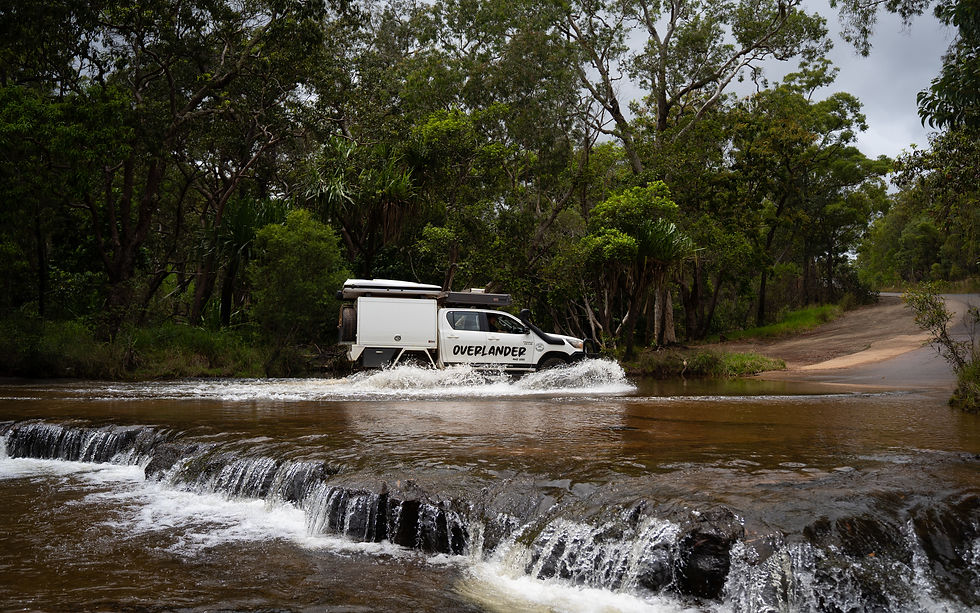
It's important to let you know that driving through streams, rivers, creeks, dams and floodwaters is prohibited and done so at the hirers own risk. Damage caused by water is not covered by our insurance.
If you choose to drive into or through a body of water:
Walk it First (Safe Areas Only): If the water is clear and it is safe to do so, walk the crossing to check the depth and locate any underwater boulders or holes. Note: In Northern Australia, always be mindful of saltwater crocodiles. If it's a known crocodile habitat, do not walk the water. Watch another vehicle cross first, or use a stick to gauge depth from the bank.
Engage 4WD: Put the vehicle into 4WD before entering the water.
Keep Moving: Do not change gears or stop in the middle of the river. Maintain steady momentum until you are completely out on the other side.
5. Bull dust and Bullets: Sharing the Road

Outback roads are shared with massive transport vehicles known as Road Trains—trucks hauling up to four massive trailers.
Give Road Trains Space: Road trains cannot stop quickly, and they throw up massive clouds of dust and rocks. If you see a road train approaching from the opposite direction, slow down, pull over as far left as safely possible (or onto the shoulder), and stop. Wait for the dust cloud to clear completely before moving again.
Overtaking: Never try to overtake a road train unless you have absolute, clear visibility for kilometers ahead.
Oncoming vehicles: Slow down and pull over for oncoming vehicles to avoid windscreen and other damge. Don't always expect the same from other road users so be prepared.
Communicate: Radio truckies and other road uses on UHF Channel 40 if you have one; truckies are incredibly helpful and will tell you when it is safe to pass.
Tip: Road trains and large vehicles will often put their right hand indicator on to let you know when to pass.
6. Preparation and Self-Sufficiency
Remote means exactly that—there is no mobile phone reception, no corner stores, and emergency services can take days to reach you.
Communication: Carrying an emergency communication device is highly recommend in remote arears such as the Simpson Desert or Cape York. Some of our vehicles come equipped with a Personal Locator Beacon and we can refer you to specialist Satellite phone rental companies if needed.
Water and Fuel Supply: Always carry more than you think you need. A good rule of thumb is at least 5–7 liters of drinking water per person, per day, plus emergency reserves. Calculate your fuel consumption generously—vehicles use significantly more fuel pushing through soft sand, mud, and heavy corrugations.
Download Offline Maps: Apps like Hema Maps or Wikicamps are essential. Download your maps completely before leaving major towns, as GPS navigation requiring cellular data will not work.
Tip: Download 'offline' maps in Google Maps before you loose internet connectivity
7. Expect the Unexpected
Problems do occur, even with modern, well-maintained vehicles and equipment. The chance of damage, a fault, or something going wrong increases significantly when any vehicle is driven on unsealed roads.
If you are traveling to places such as the Gibb River Road or Cape York or anywhere where there are long sections of rough, corrugated roads the chances of a problem increases even more.
If there is a problem with your 4WD camper during your hire, be prepared to work with us to resolve the issue and depending on the problem and where you are located a delay or change to your travel plans.
A Final Note: Respect the Track
The secret to a successful Outback trip is patience. If you treat the vehicle with respect, drive to the conditions, and take your time, you will navigate the harshest roads Australia has to offer with ease.
Pack your sense of adventure, leave the rush behind, and enjoy the incredible journey ahead! Safe travels!

Comments